1. Service Overview
BiFC (Bimolecular Fluorescence Complementation) is a powerful method to study protein-protein interactions in living cells. It enables visualization of interactions by reconstituting a fluorescent protein from two non-fluorescent halves fused to interacting proteins.
YBioHub provides a professional BiFC platform using plant and animal cell systems, offering precise and reliable results.
2. Principle
The BiFC assay works by splitting a fluorescent protein (e.g., GFP, YFP, or RFP) into two non-fluorescent fragments and fusing each fragment to one of the proteins of interest:
- When the two proteins interact in cells, the fluorescent protein fragments complement each other and emit fluorescence.
- Fluorescence indicates the physical interaction and subcellular location of the interacting proteins.
- Observation is done using confocal or fluorescence microscopy.
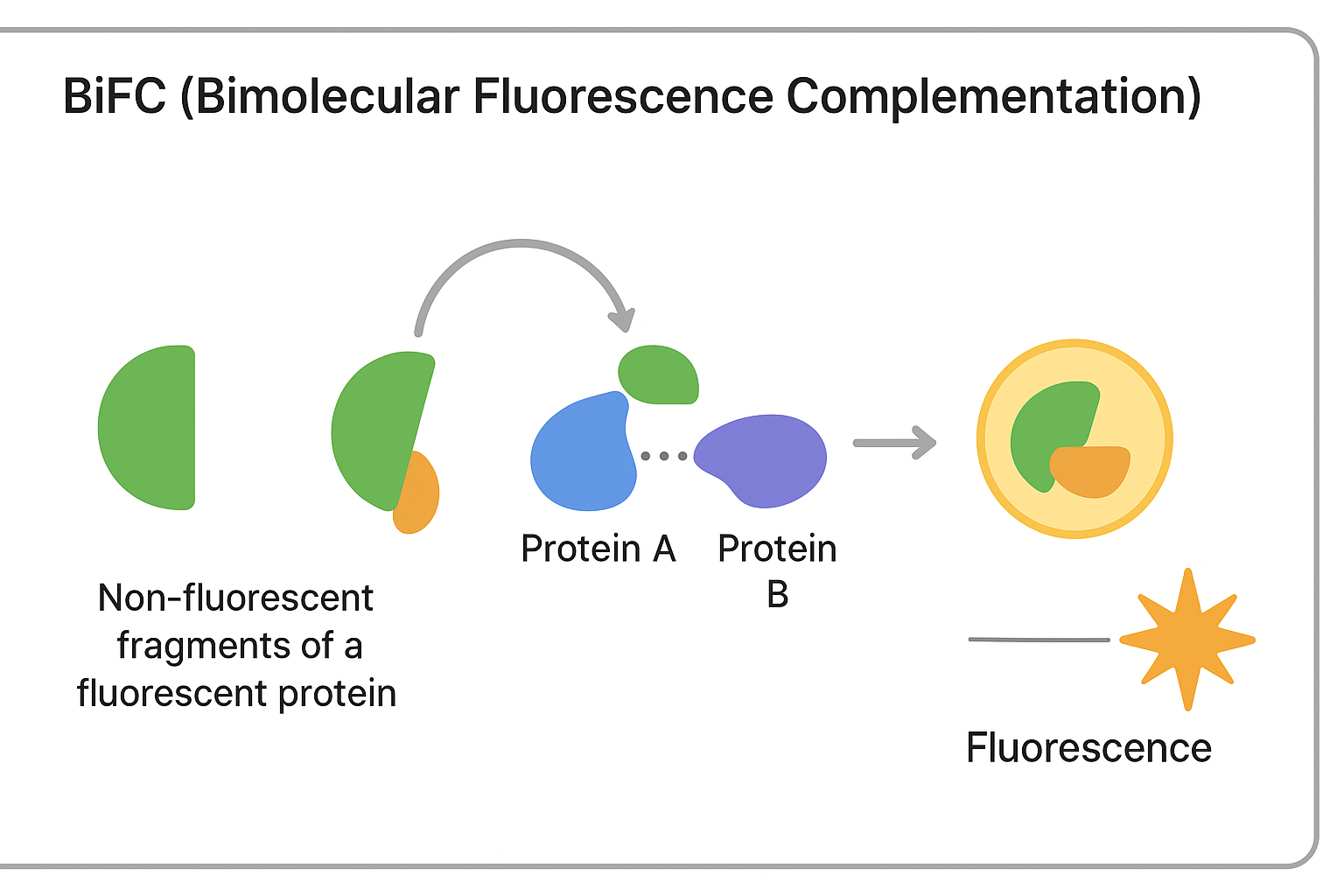
Figure: Visualization of protein-protein interactions using BiFC.
3. Experimental Workflow (Simplified)
- Gene cloning & vector construction for fusion proteins
- Co-transformation/transfection into host cells
- Fluorescence microscopy to detect interactions
- Data analysis and interaction validation
4. Applications
- Identification of protein-protein interactions
- Subcellular localization of interacting complexes
- Validation of signaling pathways
- Support for functional genomics and molecular biology studies
5. Service Advantages (YBioHub)
- 📌 Experienced team with expertise in multiple host systems
- 📌 Supports GFP, RFP, YFP, and other fluorescent proteins
- 📌 High-quality imaging and interaction analysis
- 📌 Fast turnaround and reliable results
6. Deliverables
- Fluorescence microscopy images of interacting proteins
- Experimental analysis report
- Raw data files upon request
7. FAQ
Q1: Which cell systems can be used for BiFC?
A: Plant transient expression (tobacco leaves), Arabidopsis stable transformation, yeast, and mammalian cells are commonly used.
Q2: How long does a BiFC experiment take?
A: Typically 3–5 weeks, depending on host system and vector construction.
Q3: Can multiple fluorescent proteins be used?
A: Yes. GFP, YFP, RFP, or other variants can be used depending on experimental design.
Q4: I only have the gene sequence, not the vector. Can I still order this service?
A: Yes. We provide one-stop service from gene cloning to vector construction.
Q5: What are the final deliverables?
A: Fluorescence images, a detailed interaction analysis report, and raw data files if requested.